
Can VR Really Close the Education Gap? Over 30,000 Students Say Yes
- fabiotabora
- 29 oct 2024
- 3 Min. de lectura
Educational inequality remains a barrier for millions of children, particularly in rural or underserved areas. At PIXDEA, we've seen firsthand the impact that virtual reality (VR) can have by delivering high-quality educational experiences to communities with limited access. Since 2020, we’ve reached over 30,000 students, providing them with an immersive platform to learn fundamental topics—ranging from financial literacy and online safety to healthy eating habits—through practical, interactive VR experiences.

Educational Inequality: A Persistent Challenge
According to a UNESCO report, over 50% of students in rural areas across many Latin American countries lack access to quality education due to infrastructure and resource constraints. This educational gap can perpetuate poverty, limiting growth and success opportunities for new generations.
The Power of VR for Inclusive Education
Virtual reality offers an innovative solution to this problem. By immersing students in three-dimensional, interactive environments, VR enables them to explore complex topics in an intuitive, memorable, and accessible way. PwC studies reveal that VR-based learning environments can improve information retention by 40% compared to traditional methods by engaging both visual and experiential learning in a safe setting.
Real Impact: PIXDEA’s Educational Experiences
At PIXDEA, we are committed to closing the educational gap and providing meaningful learning opportunities to students in all regions. Through a series of VR experiences, we tackle critical topics for student development:
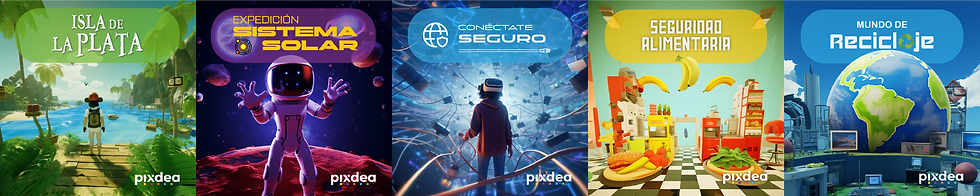
Isla de la Plata: In this experience, students learn the basics of financial literacy, such as saving and investing. Exploring an interactive island, children earn virtual “money” by completing tasks, learn to invest, and finally, open their first bank account in the Metaverse—understanding the value of saving in a hands-on way.
Conéctate Seguro (with Tigo): Focused on online safety, this experience addresses internet risks, teaching children to identify and avoid dangers such as online predators. Through VR, students learn digital safety practices—a crucial skill in today’s world.
Cyberbullying (with Tigo): Aiming to promote positive digital interactions, this experience teaches students about the emotional and social effects of cyberbullying, as well as practices for creating a supportive online environment. Students gain a deep understanding of empathy and respect online.
Piensa Antes de Conducir Kids (with Bridgestone): This educational experience introduces students to road safety, from crossing streets safely to basic concepts like tire-changing and other essential measures they’ll need to know as future drivers. Students leave with valuable road safety knowledge.
Food Safety: Through this experience, students learn the importance of balanced nutrition, identifying which foods are for moderate consumption and which are ideal for daily intake. VR makes these nutrition concepts visually engaging and practical.
Evidence of VR’s Success in Education
Numerous studies have demonstrated the positive impact of immersive learning. Research from Stanford University shows that students learning in VR environments develop a deeper understanding and retain information longer. In fact, a University of Maryland study suggests VR learning can increase retention up to 90%, compared to 30% with traditional methods.
PIXDEA’s experiences not only teach technical skills but also prepare students emotionally and socially. Feedback from children and educators who’ve participated in our experiences highlights a more intuitive, meaningful learning process. One participant shared, “I learned how to save my money in Isla de la Plata, and now I want to open my own savings account in real life.” Another student who explored Cyberbullying expressed they gained a profound appreciation for empathy and online respect in a way they hadn’t experienced before.
At PIXDEA, we believe that inclusive, high-quality education shouldn’t depend on location or resources. Through virtual reality, we’re building a bridge to equitable and accessible learning for everyone. Our commitment is to continue expanding these educational experiences to reach even more students and positively transform their futures.
Interested in bringing VR education to more communities?
If you’d like to learn how PIXDEA can bring these experiences to your institution or community, get in touch with us. Together, we can make a lasting, positive impact on education!


